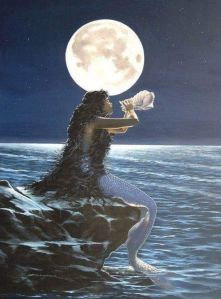
It is said that one should never take a mirror or comb that you find laying on the beach, for it may belong to a mermaid who will soon come back looking for it…
For as long as humans have been able to tell stories, tales of mermaids and water beings have existed across cultures and landscapes for thousands of years. From the ancient rivers and coasts of Africa to the warm and sun-swept seas of the Caribbean, stories of mermaids and fish people continue to warn, frighten, enchant, and inspire curiosity across the world. Most of these stories serve as warnings and means of protection for local communities, as mermaids have been known to lure, kidnap, and sometimes kill people if they are not careful. Like fairies and other nature spirits of the land and forests, mermaids are another diverse group of Hidden People who are equally respected as they are feared, and in some cases venerated.
While some stories portray them to be visually terrifying and ugly creatures, others describe mermaids as possessing an otherworldly beauty, with their skin and scales coming in all shades of silvers, browns, blues, and greens, with varying hair types and textures. Some are said to resemble humans, and in other cases are able to shapeshift into any form they like.
“A workman…who has maintained a relationship with them for years insists…that all races are represented in the world of mermaids…the upper portion of the body of mermaids is human, the lower portion like a fish’s tail.”
– Mermaids and Fairymaids or Water Gods and Goddesses of Tobago, H. B. Meikle, Caribbean Quarterly
Mermaids are understood as real beings with advanced knowledge, psychic abilities, and supernatural powers that can curse as quickly as they can heal. Also known for their music, some tell of sailors and fishermen working at sea, or people going to the river to wash their clothes and suddenly being hypnotized by a beautiful song and voice that directs them to dive into the water and swim further into the deep until they can be taken under. For that reason, those working at sea may be told to wear something over their ears in certain areas where mermaids have been spotted. Those who succumb to their melodies and make it back to land are sometimes never able to enjoy music again. While there are many well-known mermaids throughout the world, below we’ll learn about a few central figures in the Caribbean and West Africa.
La Sirena / La Sirène / Simbi (Haiti-Dominican Republic)
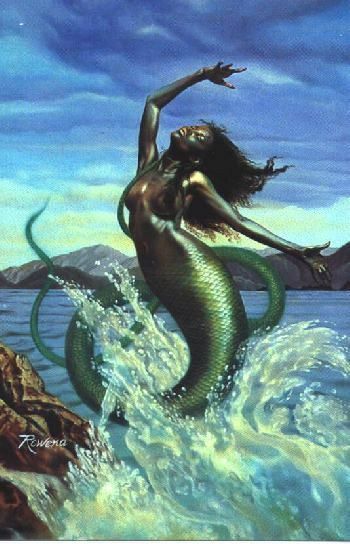
La Sirena / La Sirène, not to be confused with “siren,” is one of the most famous mermaids / lwa in the Caribbean, and has her origins as a fierce Kongo spirit who came to Ayiti (Haiti) – Quisqueya (Dominican Republic) during the transatlantic enslavement period. She is married to Agwe, another powerful lwa who rules the oceans. She is known to be very beautiful, with long black hair that she maintains with her silver comb and mirror, and she possesses a hauntingly hypnotic voice that draws in all who are chosen to hear it. Most locals on both sides of the island have been brought up with a healthy fear of La Sirena and all simbi (mermaids and serpent beings) generally, as they are known for kidnapping people for as long as seven years. However, there are many stories that speak of those who were kidnapped, eventually returning as medicine people, having learned magic from La Sirène or those in her court, and now possessing supernatural abilities to heal others from terminal illnesses.
“…Is it any wonder, then, that her children frequently have great skill as diviners? That mirror in her hands, which is the child of the watery portal our distant ancestors first sought out, reveals to us who and what we are, and in so doing, who and what we can be.”
– Dyekidon, La Sirène – A Deep Dive
There are also stories of those who return mute or deaf if they did not do what the mermaids asked of them. In general, it is advised to never swim, sing or whistle at any body of water at night – as the mermaids of La Sirène’s court may try to come and take you. When people mysteriously go missing near rivers or other bodies of water, it is typically attributed to the mermaids. The belief in them runs deep and is a regular part of everyday conversation and life.
River Mumma (Jamaica)
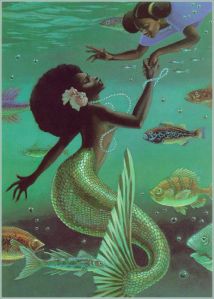
River Mumma, also known as “The River Mother,” or “The River Maid,” is a famous and respected mermaid spirit who protects all of the rivers on the island of Yamaye/Xaymaca (Jamaica), and guards a golden table left by the Spaniards when they first invaded the island on their quest for gold. All of the creatures of the rivers are considered her children, and if she finds you overfishing or trying to steal her wealth, you will be met with her anger and be killed, or cursed for life. She can sometimes be spotted combing her hair with a gold comb and singing on the rocks in the most remote and quiet spots along the local rivers of the island, and she is known to have connections to specific places that have also seen frequent flooding, disappearances, and supernatural activity like Flat Bridge and Rio Cobre. She is said to be beautiful, but that you should never make direct contact with her or attempt to touch her or speak with her, at the risk of you being hypnotized and dragged into her realm.
“River Mumma reveals the wisdom of the original inhabitants of the land, the Indigenous Taínos who named the land that is now called Jamaica, Xaymaca, meaning land of wood and water. This wisdom flows into the subsequent keepers of the land, descendants of enslaved Africans, who prophesied the current climate crisis centuries ago as a time when the rivers would run dry and all the fish would disappear because of unethical and unbridled consumption that eschews reciprocity—hallmarks of late-stage capitalism. Moreover, The Maid calls us into transatlantic waters and urges us to consider reciprocity, kinship, and our connection to one another.”
– Khytie K. Brown, River Mumma: Fluid Crossings and Mermaid Spirits in Revival Zion Religion
Fairymaids / Mermaids (Trinidad & Tobago)
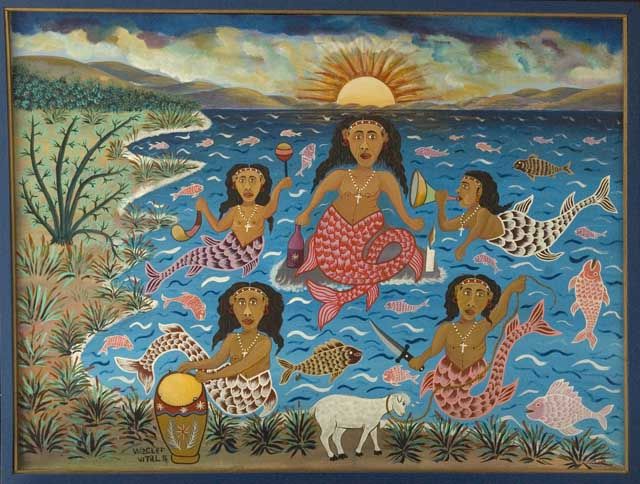
In Tobago, oral tradition speaks to magical female water spirits known as “fairymaids”, who dwell in the local rivers, and waterfalls, and mate with their male counterparts, the “mermaids” who dwell in the surrounding oceans and meet them in the local underwater caves.
“It is alleged that on afternoons, you can see the men riding the crest of waves, handsome men like warriors of long ago, richly garbed, as they go to meet the Fairymaids.”
– 30 Caribbean Folklore Legends, Marsha Gomes-McKie
These beings are well known across generations throughout the island, and it is said that their magic is able to grant wishes and great wealth to humans they favor. However, even if one were to leave them a gift in the hopes of receiving their blessings, it is just as possible for one to suddenly fall sick and die if they do not like you. There is no way to predict an outcome or any known methods to win their affections, and for this reason, dealing with them can be extremely risky and dangerous. It is also said that some fairymaids will enter into relationships with human men they find handsome, but if they are rejected, they may cast a love spell or curse them for it, causing a tormented mind.
Mami Wata (West, Central, South Africa)
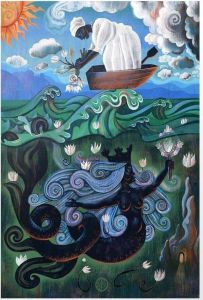
The primordial mother goddess, known across African and Caribbean Nations as Mami Wata, “Mother Water,” “Mother of the Waters,” and “Mother of Mermaids” – is arguably the most ancient, well-known, and beloved mermaid in history. As a shapeshifting deity, she has also been associated with snakes, who are often depicted wrapped around her waist as she holds a mirror and gold comb for her long black hair. Known for her extreme generosity, spiritual protection, fertility, and beauty, she has a unique multi-cultural history with origins on the West African coast that have since spread across the continent and diaspora. From Nigeria to Benin, Togo, Ghana, and beyond, the relevance of Mami Wata throughout each region can be heavily felt.
Her devotees offer luxurious and lavish ceremonies, offerings, and meals in her honor – and she is frequently sought out by community members to cure illnesses, and to ensure fertility and safe pregnancies. As much as she is loved and admired for the blessings she can bring, she is also feared and highly respected for her authority and power over the waters, animals, and other natural forces. All marine life is under her domain and protection, and Mami Wata herself can be viewed as a collective of water spirits, including those like La Sirena and River Mumma in the Caribbean. She blesses those who are loyal to her and protect her creatures, and vengeful to those who harm and mistreat her realm.
“Mami Wata can be male, female, or both and may appear in vivid dreams, through sleep paralysis, or as humans, mermaids, and various animals [aquatic and non-aquatic]. For devotees, Mami Wata aids in clairvoyance, healing, love, good fortune, childbirth, and more. While some have an innate connection, initiation is essential for safe and effective interaction…”
– Sena Voncujovi, Who Is Mami Wata: My Encounters from Africa to Asia
Sources & Further Reading
- “La Sirène – a Deep Dive.” Lwa and Order, 23 May 2023, lwaandorder.com/2023/05/23/la-sirene-a-deep-dive/
- Chronicles of a Zoe. “The QUEEN of the Sea – LA SIRENE (SIRENS vs MERMAIDS)” 15 Apr. 2021, www.youtube.com/watch?v=EYnMkUjPA5Y ; “🧜🏾♀️ MAMI WATA: The MOTHER of ALL Mermaids 🐍” 6 Sept. 2022, www.youtube.com/watch?v=vfHqr-8rgLk
- Gomes-McKie, Marsha. 30 Caribbean Folklore Legends. Independently Published, 30 Sept. 2022.
- The Legend of River Mumma: https://www.tiktok.com/@daviddacosta73/video/7534709493079280926?is_from_webapp=1&sender_device=pc
- “TELL ME A STORY: River Mumma and the Golden Table (a Jamaican Folktale).” http://www.gosanangelo.com, archive.gosanangelo.com/lifestyle/tell-me-a-story-river-mumma-and-the-golden-table-a-jamaican-folktale-ep-439870719-356823561.html/
- Sharpe, Susanna. “River Mumma: Fluid Crossings and Mermaid Spirits in Revival Zion Religion.” PORTAL, 17 Oct. 2023, sites.utexas.edu/llilas-benson-magazine/2023/10/17/river-mumma-fluid-crossings-and-mermaid-spirits-in-revival-zion-religion/
- Meikle, H. B. “Mermaids and Fairymaids or Water Gods and Goddesses of Tobago.” Caribbean Quarterly, vol. 5, no. 2, 1958, pp. 103–08. JSTOR, http://www.jstor.org/stable/40652607
- See U in History / Mythology. “Mami Wata – the Mermaid Goddess of African Folklore.” YouTube, 3 July 2025, www.youtube.com/watch?v=_uI1zYTTFoY
- African Cultures and Myths. “Mami Wata: The African Water Spirit of Beauty, Power & Mystery.” YouTube, 29 Sept. 2025, www.youtube.com/watch?v=BAZXUDCuLNQ
- Africa Unveiled. “Mami Wata: The Ancient Water Goddess Who Still Haunts Africa’s Rivers Today | African Mythology.” YouTube, 7 Mar. 2025, www.youtube.com/watch?v=oIj7Y09lbXY
- Encounters, My. “ReVodution: Voodoo Education & Solutions.” ReVodution: Voodoo Education & Solutions, 13 Aug. 2024, www.revodution.com/blog/who-is-mami-wata-my-encounters-from-africa-to-asia
- Meram, Christine. “The Legend of Mami Wata.” History of Mermaids, 25 June 2022, historyofmermaids.com/the-legend-of-mami-wata/
- rebekah’s Journey. “Taken by Mermaid Storytime 😳🧜♀️.” YouTube, 31 Mar. 2024, www.youtube.com/watch?v=nqdiALnTI9U

 Ancient Pathways Tarot